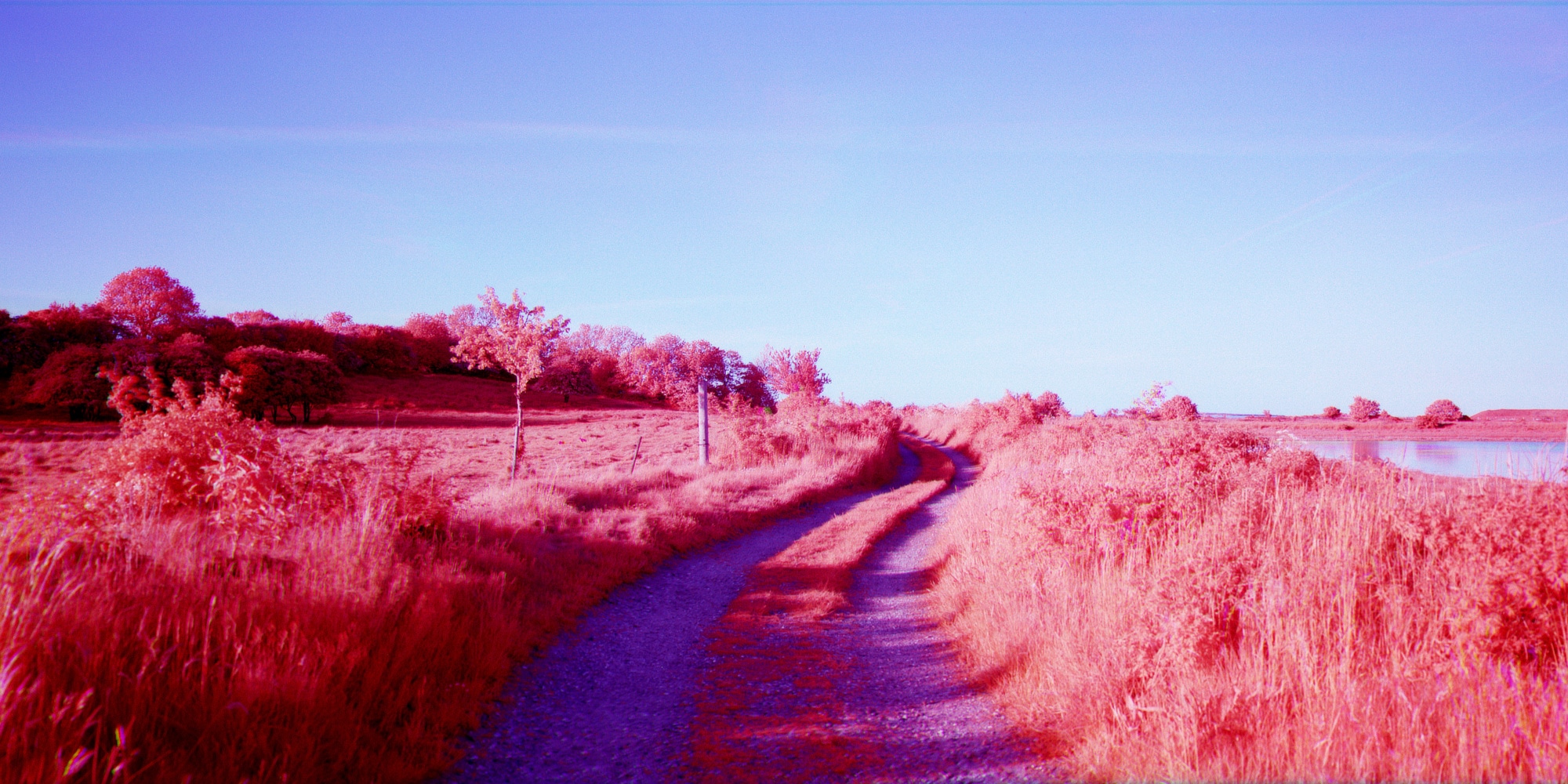
Replicating Aerochrome with infrared trichromes
Introduction
Since being introduced to Kodak Aerochrome, I’ve always been curious to try it. Its otherworldly look works particularly well on the large 6×17 format. But I never could swing the $300+ price per roll that Aerochrome goes for nowadays. So, I decided to try the much cheaper alternative, which is trichroming with black & white infrared film.
There’s a very good blog post written by Joshua Bird, where he goes very in-depth on how to faithfully recreate the Aerochrome look with different filters on B&W IR film. Joshua’s method, while more technically correct, requires five different filters, and that complicates things too much for my liking. Instead, I took the advice of Fabri and settled for a basic IR, green, and blue filter set. That gets me very close to the look that I’m after, while simplifying the process quite a bit.
The filters
I ended up getting a Hoya R72 infrared filter, a Tiffen green #58, and a Tiffen blue #47. The R72 filter is especially interesting, because it blocks light wavelengths of up to 720nm, which is close to where visible light ends and infrared light begins. That’s obviously important for infrared photography, where you want to isolate and capture just the infrared light.
First try & lessons learned
To test my new filters and the trichrome process, I went on a trip to Faxe Kalkbrud (a limestone quarry in Denmark), where the water is a beautiful bright blue — a color that contrasts nicely with the red vegetation on infrared trichromes.
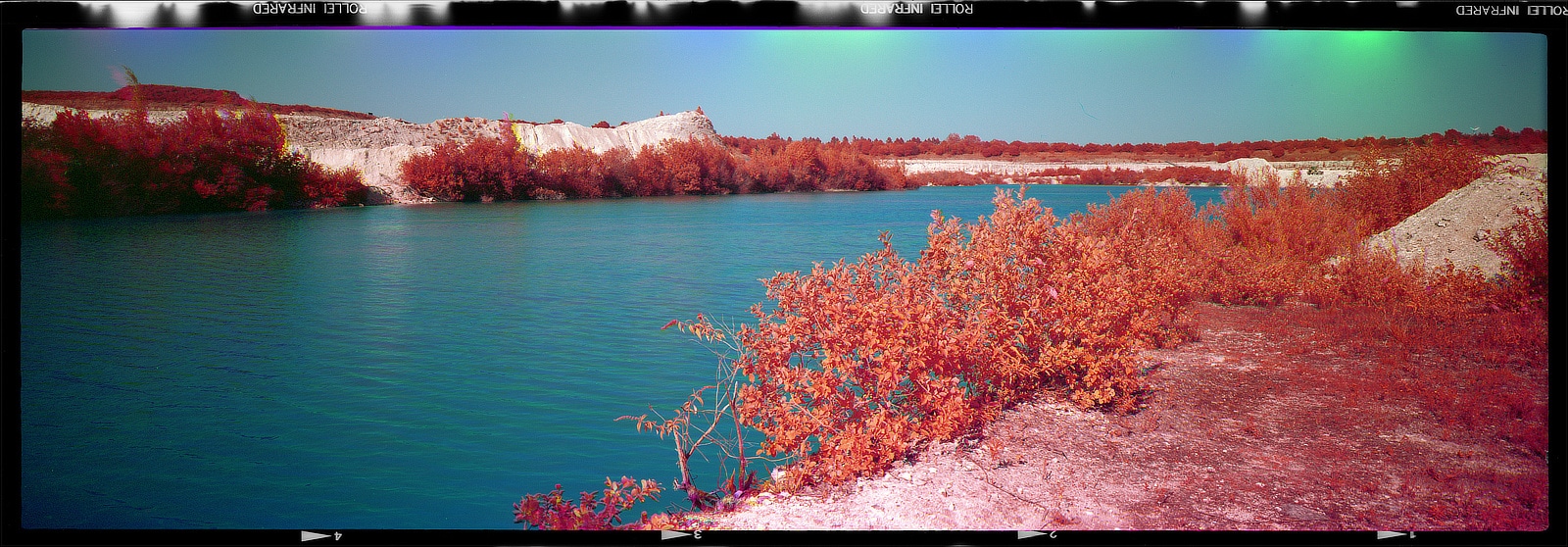
I shot my first roll of Rollei Infrared on my Noble Design 6x17 camera and rated it at ISO 200. My first attempt at IR trichroming sells the Aerochrome look successfully, I think. There are some light leaks at the top, which I suspect are from loading the film in broad daylight. I’ve since learned it’s best to load infrared film in complete darkness, due to the sensitivity of these emulsions.
Since I'm shooting 6x17, I'm only getting one trichrome image per roll of 120 film. That's because 120 only fits four 6x17 shots on a roll, and a trichrome requires three separate shots. So, one roll equals one IR trichrome and one spare black & white IR image.
One tip I have when metering is to use a phone metering app when metering through the R72 filter. I prefer metering with a dedicated light meter, but I found that those do not work with the extremely dark R72 filter. My iPhone has no such problem. The app I use is called myLightMeter PRO. It's not free, but it has all the features I need and it's accurate in my experience.
Another thing to keep in mind is that because the R72 filter is so dim, your exposure quickly becomes very long. And with reciprocity failure, that often adds even more seconds to your exposure. You can imagine trees and bushes looking quite blurry, even in only slightly windy conditions. So, you probably want to shoot on a calm day with very little wind. You can shoot on cloudy days, but the clouds will drift in between shots, creating colorful rainbow clouds.
Second try & nailing the look
For my second roll of Rollei Infrared, I took a ferry to the small Danish island, Samsø, and went to a location with lots of vegetation that I had scouted on an earlier trip. It has a perfectly curved gravel road and some water to add visual interest.
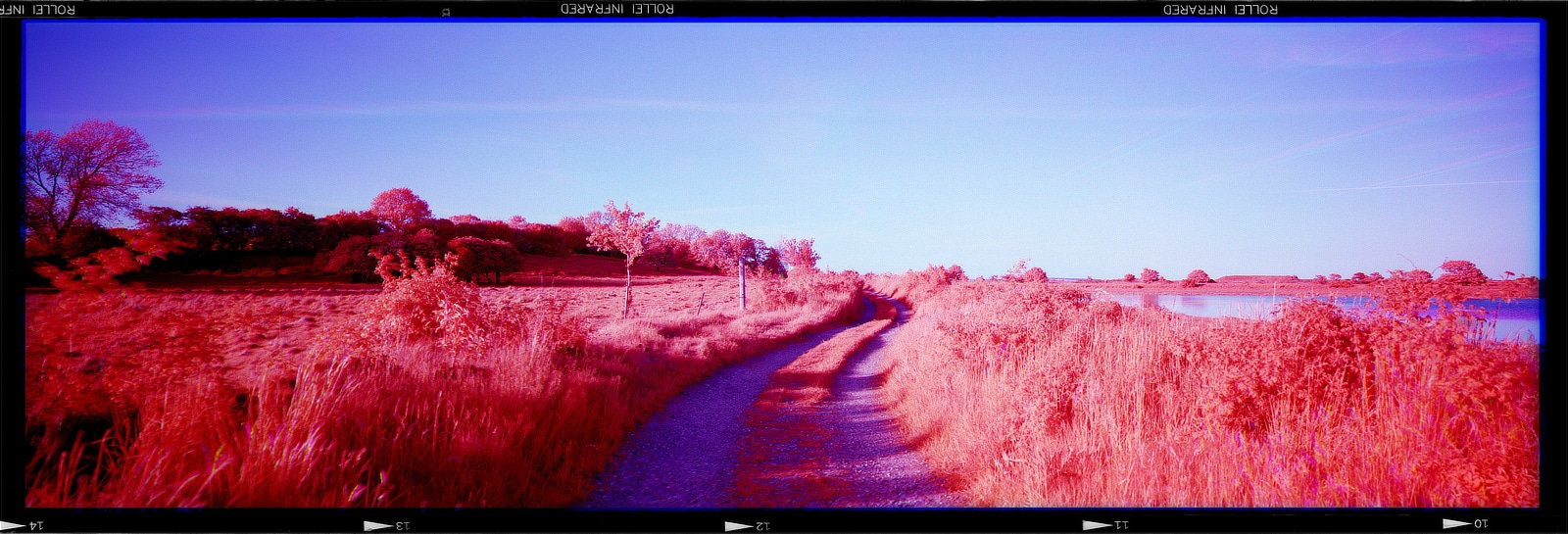
This one got me a lot closer to my preferred Aerochrome "look" with more pink vegetation and purple shadows. What did I do differently? The most obvious difference was the time of day it was shot. My first roll was shot during the afternoon when the sunlight was still relatively direct and harsh. But this second roll was shot in the evening when the sun was much lower, giving more depth and shadow. I also think the way these (six different) images were scanned and composited had a big impact.
Putting the trichrome together
The final step of combining the trichrome is pretty simple, but it can take a while to get right. You will need some photo editing software for this. I use Affinity because it's free.
To start, import all three shots into one project and make sure the color format is set to RBG/16 (in Affinity, this setting is inside "Document Setup"). Make sure to keep track of which shot was taken with which filter and label each layer appropriately.
The trick is to apply a "Channel Mixer" adjustment layer to each of the three layers. For the IR layer, set red to 100% and blue/green to 0%. For the green layer, set green to 100% and red/blue to 0%. For the blue layer... you get the point. Once each layer has its own adjustment layer, set their blend mode to "Add." At this point you should have something that resembles Aerochrome, but you're not done yet.
Move the images around so they all align on top of each other. Film curl and minor perspective shifts during scanning is inevitable, so you can use the "Mesh Warp" tool to try and correct this if deemed necessary.
The secret to getting the color mixture just right is to add a "Brightness & Contrast" adjustment layer to each of the three layers and play around with the brightnesses.
Final thoughts
If you look at images taken with real Aerochrome, you'll notice they can have many different looks. Like any film, there are so many variables that determine the final result, such as how it was exposed, what time of day it was exposed, filters used, the condition of the film, how it was processed (E6 vs C-41), and how it was scanned. Some Aerochrome images have very pink foliage (most famous example being Richard Mosse's photo series in Congo), while others have a deep crimson appearance. It being a slide film with limited dynamic range contributes to lots of overexposed skies, and the overall age of today's available stock generally means getting good images will be quite unreliable.
Anyways, I guess my point is the trichrome method does indeed produce images that look very similar to real Aerochrome, because real Aerochrome can be made to look in many different ways.
Each image (and consequently each roll) came in at around US$26, including development. That's a lot cheaper than the real thing, but still very expensive. I can see myself shooting 6x17 IR trichromes once every couple of years, just for the cool factor. I will be testing this method on my XPan, which should yield around 6 or 7 trichromes per roll, making it a lot more economical.
For now, I'm pretty happy with these two panoramas. Follow me on Instagram to see more of my panoramas and other film photography.